Lend-Lease oli Yhdysvaltain liittovaltion toisen maailmansodan aikainen ohjelma, joka mahdollisti sotamateriaalin toimittamisen ensin Britannialle ja vuoden 1942 alusta lähtien Neuvostoliitolle ja myös muille liittoutuneille.
Ohjelma alkoi 11. maaliskuuta 1941 ja se lopetettiin 2. syyskuuta 1945.
------------
President Roosevelt signs the Lend-Lease bill to give aid to Britain and China (1941)
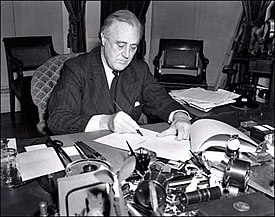 The Lend-Lease policy, formally titled An Act to Further Promote the Defense of the United States, (Pub.L. 77–11, H.R. 1776, 55 Stat. 3034, enacted March 11, 1941) was a program under which the United States supplied Great Britain, the USSR, Free France, the Republic of China, and other Allied nations with materiel between 1941 and August 1945.
It was signed into law on March 11, 1941, a year and a half after the outbreak of World War II in Europe in September 1939 and nine months before the U.S. entered the war in December 1941.
The Lend-Lease policy, formally titled An Act to Further Promote the Defense of the United States, (Pub.L. 77–11, H.R. 1776, 55 Stat. 3034, enacted March 11, 1941) was a program under which the United States supplied Great Britain, the USSR, Free France, the Republic of China, and other Allied nations with materiel between 1941 and August 1945.
It was signed into law on March 11, 1941, a year and a half after the outbreak of World War II in Europe in September 1939 and nine months before the U.S. entered the war in December 1941.
A total of $50.1 billion (equivalent to $656 billion today) worth of supplies were shipped, or 17% of the total war expenditures of the U.S. In all, $31.4 billion went to Britain, $11.3 billion to the Soviet Union, $3.2 billion to France, $1.6 billion to China, and the remaining $2.6 billion to the other Allies. Reverse Lend-Lease policies comprised services such as rent on air bases that went to the U.S., and totaled $7.8 billion; of this, $6.8 billion came from the British and the Commonwealth.
The terms of the agreement provided that the materiel was to be used until time for their return or destruction. In practice very little equipment was returned. Supplies that arrived after the termination date were sold to Britain at a large discount for £1.075 billion using long-term loans from the United States. Canada operated a similar program called Mutual Aid that sent a loan of $1 billion and $3.4 billion in supplies and services to Britain and other Allies.
The United States did not charge for aid supplied under this legislation.
This program effectively ended the United States' pretense of neutrality and was a decisive step away from non-interventionist policy, which had dominated United States foreign relations since 1931.
The Lend-Lease Memorial in Fairbanks, Alaska commemorates the shipment of U.S. aircraft to the Soviet Union along the Northwest Staging Route.
 BM-13N Katyusha on a Lend-Lease Studebaker US6 truck, at the Museum of the Great Patriotic War, Moscow.
------------
Englanti lähetti neuvostoliittoon 1942-1945 aikana 7.000 kpl panssarivaunuja
Vaunut olivat Mathilda-II, Churhill-II, Churhill-III, Crusader Mark-I, Crusader Mark-IV sekä Tetrach ja Churhill Crogodile tyyppejä + 200 miehistön kuljetus panssareita.
BM-13N Katyusha on a Lend-Lease Studebaker US6 truck, at the Museum of the Great Patriotic War, Moscow.
------------
Englanti lähetti neuvostoliittoon 1942-1945 aikana 7.000 kpl panssarivaunuja
Vaunut olivat Mathilda-II, Churhill-II, Churhill-III, Crusader Mark-I, Crusader Mark-IV sekä Tetrach ja Churhill Crogodile tyyppejä + 200 miehistön kuljetus panssareita.
Englanti lähetti neuvostoliitoon Valentine tankkeja yhteensä 1300 kpl (ei 1-tyyppi)
Kanada lähetti neuvostoliittoon 1942-1945 aikana Ram ja Valentine panssareita.
Kanada valmisti 1420 valentine ja 2000 Ram tankkia vuosien 1941 - 1943 aikana.
Kanada lähetti neuvostoliittoon Valentine ja Ram (sherman) panssarivaunuja.
Valentine tankkeja oli 1380 kpl. Perille näitä vaunuja saapui 1118 kpl.
Luftwaffe upotti yhteensä 192 kanadan valentine vaunua.
USA lähetti neuvostoliiittoon 1942- 1945 aikana 13.303 kpl
Näistä Luftwaffe upotti 6238 panssarivaunua (norjan tukikohtien lentokoneet)
Minun mielestäni lukuun sisältyy myös kanadan lähettämät tankit.
M3 Stuart, M3 Grant / M3 Lee, M4 Sherman, Sherman Grab panssarivaunuja.
T48 / 57 mm tykki half-track, yhteensä 650 kpl
M10 vaunuja 52 kpl
M15 vaunuja 100 kpl
M17 vaunuja 1000 kpl
M18 vaunuja 5 kpl (testi malleiksi)
Telaketjuilla liikkuvia panssaroituja kenttätykkejä 1800 kpl
Lisäksi toimitettiin paljon White M3A1 puoli-tela panssariautoja
Kevyiden M3 vaunujen parannettu versio oli M5, jonka ensimmäisen sarjan vaunujen moottori oli lentokoneen 7 sylinterinen otto, 250 hp / 184 kw, ilmajäähdytetty, bensiini.
Lievittämään säteittäisten lentokoneiden moottorien kysyntää M3 vaunuissa kehitettiin uudistettu versio, jossa käytettiin kahta erillistä Cadillac V-8 auton moottoria, joiden vaihteistona oli kaksois Hydra-Matic voimansiirto, erillisen jakovaihteiston avulla.
GM Hydra-Matic oli momentinmuuntimen ja planeettavaihteiston yhdistelmään perustuva automaattivaihteisto.
Tämä muunnelma oli hiljaisempi, viileämpi ja tilavampi. Automaatti vaihteistosta johtuen se on myös yksinkertaisempi miehistön koulutuksessa.
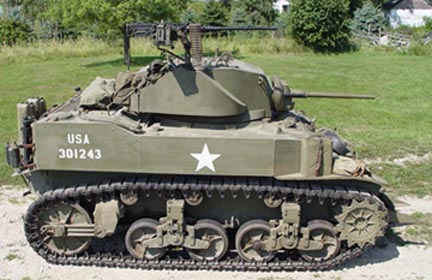
Tätä uutta panssarivaunu mallia kutsuttiin aluksi nimellä M4 mutta nimettiin uudelleen M5 tyyppi, jotta vältetään sekaannukset M4 vaunujen kanssa. M5 panssarivaunussa oli uusittu viisto keulalevy ja kuljettajan ajoluukut siirrettiin tämän keulalevyn päälle.
Ensisijaisina arvostelun kohteena käytettiin, että Stuart vaunussa ei ollut tulivoimaa, jota haluttiin parantaa. M5 sarjassa säilyi 37 mm tykki, joka korvattiin hieman pidempi putkisella, tyyppi M6 tykillä.
M5 korvasi vähitellen tuotannossa vuodesta 1942 olleet M3 vaunut ja sitä puolestaan seurasi Light Tank M24 valmistuksen aloitus vuonna 1944.
Kun Yhdysvaltain armeijan liittyi Pohjois-Afrikan kamppailuihin loppuvuodesta 1942, Stuart yksiköt muodosti yhä edelleen suuren osan panssari voimien vahvuudesta.
Tuhoisan Kasserine solan taistelu jälkeen USA seurasi nopeasti brittejä ja hajaannutti suurimman osan kevyistä tankeista pataljoonien kesken ja alisti vaunut keskiraskaita panssarivaunuja käyttävien pataljoonien kesken suorittamaan perinteisen ratsuväen tehtäviä partiossa ja seurantaan.
Sodan loppupuolella monilla Yhdysvaltain armeijalla oli kolme M4 Sherman ja yksi M3s ja M5/M5A1 panssarivaunu pataljoona.
Vaikka Stuart vaunut oli tarkoitus korvata kokonaan uusilla M24 Chaffee panssareilla, tuotettujen M5 panssarivaunujen määrä oli suuri, noin 11.100 kpl, mukaan luettuna 75mm M8 telatykkien tuotanto.
M5 tankki jäi palvelukseen sodan loppuun asti ja hyvin pitkään myös sodan jälkeen.
USA, Britannia ja Neuvostoliitto olivat M5A1 ensisijaisia käyttäjiä, sitä käytettiin lisäksi Ranskassa ja toisen maailmansodan jälkeen myös Kiinassa.
---------------------------------
M5 Light
Paino: 15 tonnia
Pituus: 4,84 m
Leveys: 2,28 m
Korkeus: 2,3 m
Miehistö: 4
Panssarointi 13 - 51 mm
Aseistus: 1 x 37 mm tykki / 174 laukausta + 3x .30 cal konekiiväriä / 7500 patruunaa
Moottori: 2 x V-8 Cadillac 110 hp x 2 / 346 cu.in. (litteä pää / flat head) bensiini moottoria
(Twin Cadillac engines. Redesigned hull similar to M3A3, but with vertical sides and raised engine deck)
(Turret as for M3A1)
A detailed image of the front-mounted transfer unit is shown here. This assembly was connected by the universal joints at the bottom of the image to the propellor shafts that came from the transmissions and combined the two power flows into one. It also provided a two-speed hydraulic-controlled gear reduction.
-------------------------------------
To relieve the demand for the radial aero-engines used in the M3, a new version was developed using twin Cadillac V-8 automobile engines and twin Hydra-Matic transmissions operating through a transfer case.
During the war, the Hydramatic was used in a variety of military vehicles, including the M5 Stuart tank (where two of them were mated to twin Cadillac V8 engines) and the M24 Chaffee light tank (after war advertised as "battle-tested.").
This variation was quieter, cooler and roomier. Owing to its automatic transmission it also simplified crew training.
The new model, initially called M4 but redesignated M5 to avoid confusion with the M4 Sherman also featured a redesigned hull with sloped glacis plate and driver's hatches moved to the top.
Although the main criticism from the units using it was that the Stuarts lacked firepower, the improved M5 series kept the same 37 mm gun.
The M5 gradually replaced the M3 in production from 1942 and was, in turn, succeeded by the Light Tank M24 in 1944.
When the U.S. Army joined the North African Campaign in late 1942, Stuart units still formed a large part of its armor strength.
After the disastrous Battle of Kasserine Pass, the U.S. quickly followed the British in disbanding most of their light tank battalions and subordinating the Stuarts to medium tank battalions performing the traditional cavalry missions of scouting and screening.
For the rest of the war, most U.S. tank battalions had three companies of M4 Shermans and one company of M3 Medium and M5/M5A1s.
Though the Stuart was to be completely replaced by the newer M24 Chaffee, the number of M5s produced was so great (about 11,130 including the 75mm HMC M8) that the tank remained in service until the end of the war, and well after. In addition to the U.S, UK and Soviet Union, who were M5A1 the primary user it was used by France, and after war also China.


