Its purpose was to secure Iranian oil fields and ensure Allied supply lines (see Persian Corridor ) for the USSR, fighting against Axis forces on the Eastern Front . Though Iran was neutral, the Allies considered King Reza Shah to be friendly to the Axis powers, deposed him during the subsequent occupation and replaced him with his young son, Mohammad Reza Pahlavi.
In 1925, after years of civil war, turmoil and foreign intervention, Persia was unified under the rule of Reza Khan, who crowned himself to become Reza Shah that same year. Later, in 1935, he asked foreign delegates to use the term Iran, the historical name of the country, used by its native people, in formal correspondence. He set on an ambitious program of economic, cultural, and military modernisation. Iran, which had been a divided and isolated country under the rule of the Qajar Dynasty, was now rapidly evolving into a modern industrial state.

Reza Shah also made many improvements, such as building infrastructure, expanding cities and transportation networks, and establishing schools. He also set forth on a policy of neutrality , but to help finance and support his ambitious modernisation projects, he needed the help of the west.
For many decades, Iran and the German Empire had cultivated ties, partly as a counter to the imperial ambitions of Britain and the Russian Empire (and later, the Soviet Union). Trading with Germany appealed to Iran because the Germans did not have a history of imperialism in the region, unlike the British and Russians. Iranian embassies in occupied European capitals rescued over 1,500 Jews and secretly granted them Iranian citizenship, allowing them to move to Iran.


The British began to accuse Iran of supporting Nazism and being pro-German. Although Reza Shah declared neutrality at an early stage of World War II, Iran assumed greater strategic importance to the British government, which feared that the Abadan Refinery (of the UK-owned Anglo-Iranian Oil Company) might fall into German hands; producing eight million tons of oil in 1940, the refinery was a crucial part of the Allied war effort. Tensions with Iran had been strained since 1931 when the Shah cancelled the D'Arcy Concession, which gave the Anglo-Iranian Oil Company the exclusive right to sell Iranian oil, with Iran receiving only 10 percent (possibly 16 percent) of the revenue. of the profits.
Following Operation Barbarossa , the German invasion of the Soviet Union in June 1941, Britain and the Soviet Union became formal Allies , providing further impetus for an Allied invasion. With the German Army steadily advancing through the Soviet Union, the Persian Corridor formed by the Trans-Iranian Railway was one of the easiest ways for the Allies to get Lend-Lease supplies to the Soviets, sent by sea from the United States. British and Soviet planners recognised the importance of that railway and sought to control it.
As increasing U-boat attacks and winter ice made convoys to Arkhangelsk dangerous, the railway became an increasingly attractive route. The Soviets wanted to make Iranian Azerbaijan and the Turkmen Sahra part of the Soviet Union or even turn Iran into a communist state. The two Allied nations applied pressure on Iran and the Shah, which led only to increased tensions and anti-British rallies in Tehran. The British described the protests as being "pro-German". Iran's strategic position threatened Soviet Caucasian oil and their armies' rear and a German advance would threaten British communications between India and the Mediterranean.
Demands from the Allies for the expulsion of German residents in Iran (mostly workers and diplomats), were refused by the Shah. A British embassy report in 1940, estimated that there were almost 1,000 German nationals in Iran. According to Iran's Ettelaat newspaper, there were actually 690 German nationals in Iran (out of a total of 4,630 foreigners, including 2,590 British). Jean Beaumont estimates that "probably no more than 3,000" Germans actually lived in Iran, but they were believed to have a disproportionate influence because of their employment in strategic government industries and Iran's transport and communications network".
However, the Iranians also began to reduce their trade with the Germans under Allied demands. Reza Shah sought to remain neutral and anger neither side, which was becoming increasingly difficult with the British/Soviet demands on Iran. British forces were already present in sizeable numbers in Iraq as a result of the Anglo-Iraqi War earlier in 1941. Thus, British troops were stationed on the western border of Iran prior to the invasion.


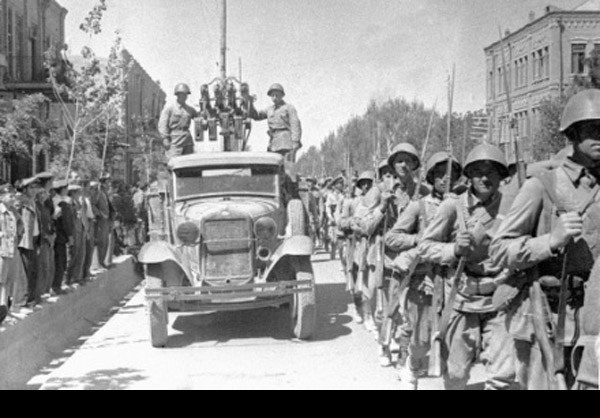
Soviet armour car and commonwealth men...




The invasion was a surprise attack, described by Allied forces as rapid and conducted with ease. Prior to the invasion, two diplomatic notes were delivered to the Iranian government on 19 July and 17 August, requiring the Iranian government to expel German nationals. The second of the notes was recognised by the prime minister Ali Mansur as a disguised ultimatum. General Archibald Wavell later wrote in his despatch, "it was apparent that the Iranian Government fully expected an early British advance into Khuzistan and that reinforcements, including light and medium tanks, were being sent to Ahvaz".
Following the invasion, Sir Reader Bullard and Andrey Andreyevich Smirnov , the British and Soviet ambassadors to Iran, were summoned. The Shah demanded to know why they were invading his country and why they had not declared war . Both answered that it was because of "German residents" in Iran. When the Shah asked if the Allies would stop their attack if he expelled the Germans, the ambassadors did not answer. The Shah sent a telegram to the US President Franklin D. Roosevelt , pleading with him to stop the invasion. As the neutral United States had nothing to do with the attack, Roosevelt was not able to grant the Shah's plea but stated that he believed that the "territorial integrity" of Iran should be respected.
The Royal Navy and Royal Australian Navy attacked from the Persian Gulf while other Commonwealth forces came by land and air from Iraq. The Soviet Union invaded from the north, mostly from Transcaucasia, with the 44th, 47th and 53rd armies of the Transcaucasian Front (General Dmitry Timofeyevich Kozlov), occupying Iran's northern provinces. Air force and naval units also participated in the battle.
The Soviets used about 1,000 T-26 tank for their combat operations.
Six days after the invasion and the ensuing Allied occupation of southern Iran, the British divisions previously known as "Iraq Command" (also known as Iraqforce) were renamed "Persia and Iraq Force" (Paiforce), under the command of Lieutenant-General Edward Quinan. Paiforce was made up of the 8th and 10th Indian Infantry divisions, the 2nd Indian Armoured Brigade, 4th British Cavalry Brigade (later renamed 9th Armoured Brigade) and the 21st Indian Infantry Brigade. The invading Allies had 200,000 troops and modern aircraft, tanks, and artillery.
In response to the invasion, the Iranian Army mobilised nine infantry divisions, some of them motorised ; two of the divisions also had tanks. The Iranian army had a standing force of 126,000–200,000 men. While Iran had taken numerous steps through the previous decade to strengthen, standardise and create a modern army, they did not have enough training, armour and air power to fight a multi-front war. Reza Shah's modernisations had not been completed by the time war broke out and the Iranian Army had been more concerned with civilian repression than invasions.
The Iranian army was armed with the vz. 24 rifle , a Czech version of the German Mauser. Iran had bought 100 FT-6 and Panzer 38(t) light tanks and additional La France TK-6 armoured cars , enough to outfit their 1st and 2nd divisions. Further Iranian orders had been delayed by World War II. While it was a large order and they were excellent tanks, they were not enough to defeat a multi-front invasion by two great powers. The changing nature of tank warfare in the 1930s made all but 50 of them obsolete when the invasion began. Prior to the attack, the Royal Air Force RAF dropped leaflets on Iranian troops, asking them not to fight and to understand their country was "not threatened" as it was being "liberated" from possible Nazi destruction.
The Iranians had little time to organise a defence, as the Allies achieved a tactical surprise. The war began in the early morning hours of 25 August, when RAF aircraft entered Iranian airspace. They bombed targets in the cities of Tehran and Qazvin and various other towns and dropped leaflets urging the Iranians to surrender. The Soviets bombed targets in cities such as Tabriz, Ardabil and Rasht . Civilian and residential areas were hit, and several hundred people were killed and wounded. Reza Shah refused requests by his generals to destroy the road and transportation networks, largely because he did not want to damage the infrastructure that he had painstakingly built during his reign. That contributed to the speedy victory of the allies.
| Anglo-Soviet Invasion of Iran | |||||||||
|---|---|---|---|---|---|---|---|---|---|
| Part of Mediterranean and Middle East theatre of World War II | |||||||||
.jpg) Soviet tankmen of the 6th Tank Division drive through the streets of Tabriz on their T-26 light tank. | |||||||||
| |||||||||
| Belligerents | |||||||||
 Australia Australia |  Imperial State of Iran Imperial State of Iran | ||||||||
| Commanders and leaders | |||||||||
 Dmitri T. Kozlov Sergei Trofimenko Dmitri T. Kozlov Sergei Trofimenko Edward Quinan William Slim Edward Quinan William Slim | Shah Rezā Pahlavi Ali Mansur Mohammad-Ali Foroughi Gholamali Bayandor † Ahmad Nakhjevan Mohammad Shahbakhti | ||||||||
| Strength | |||||||||
| Soviet: 3 armies Commonwealth: 2 divisions and 3 brigades 4 sloops 1 gunboat 1 corvette 1 armed merchant cruiser 1 armed yacht Unknown number of auxiliary vessels | 9 divisions 60 aircraft 2 sloops 4 patrol boats | ||||||||
| Casualties and losses | |||||||||
| Soviet: 40 KIA 3 planes lost Commonwealth: 22 KIA [1] 50 WIA [1] 1 tank destroyed | ~800 KIA 2 sloops sunk, 2 patrol boats captured 6 planes lost | ||||||||
| Civilian casualties: ~200 Iranian civilians killed | |||||||||

With no allies, Iranian resistance was rapidly overwhelmed and neutralised by Soviet and British tanks and infantry. The British and Soviet forces met at Sanandaj (called Senna by the British) 160 kilometres west of Hamadan) and Qazvin (called Kazvin by the British) 160 kilometres west of Tehran and 320 kilometres north-east of Hamadan) on 30 and 31 August respectively. Faced with massive defeats, the Shah ordered his military to stop fighting and stand down on 29 August, four days into the invasion.
British Invasion of Khuzestan
The British assembled a naval task force under Commodore Cosmo Graham to seize Bandar Shahpur, Abadan, and Khorramshahr. It attacked at dawn on 25 August.
The naval attack began at 04:10 at Abadan when HMS Shoreham opened fire on the Iranian sloop Palang, sinking it in a single salvo. The Abadan Refinery was of vital importance to the British commanders as well as keeping the employees of the Anglo-Iranian Oil Company safe from possible reprisals . Khuzestan province was defended by 27,000 troops from the 1st, 2nd, 6th and 16th infantry divisions, consisting of both light and mechanised infantry.
All Iranian tanks were deployed in Khuzestan as part of the 1st and 2nd divisions.
A British naval and paratrooper landing force landed at Abadan securing the city and the refinery. HMS Shoreham remained in the area and provided naval gunfire support. The Iranians managed to put up a resistance and the refinery and the city were captured that afternoon after hand-to-hand combat resulted in the deaths of several British and Indian troops.


The Australian armed merchant cruiser HMAS Kanimbla and her escorts successfully navigated the Khor Musa inlet, arriving at Bandar Shapur at 04:15. The Kanimbla successfully landed two battalions of its troops, facing no resistance from Iranian patrol boats. Seven Axis merchant vessels were seized, while an eighth was scuttled. The naval base there was secured that evening following heavy fighting.
At Khorramshahr, HMAS Yarra surprised the Iranian sloop Babr, sinking it at its dock. There had been no time to prepare resistance, as the Iranians had been taken by surprise and the head of the navy, Gholamali Bayandor, was killed.
The surprise led to virtually no resistance in other areas of Khuzestan. The RAF attacked airbases and communications and rapidly gained air superiority. They destroyed numerous Iranian aircraft on the ground, and protected their forces from Iranian counter-attacks.
The 8th Indian Division (18th Brigade plus the 25th Brigade under command from the 10th Indian Division) advanced from Basra towards Qasr Sheikh (which was taken on 25 August) across the Shatt-al-Arab waterway and captured the city of Khorramshahr, which was next to Abadan on the same day. The Karun River was not secured, as Iranian snipers remained, impeding British advance for a short time. Britain also landed troops at Bandar Abbas and the Shatt-al-Arab was secured. By 26 August, there was no organised resistance remaining in the area, with the Iranian forces overwhelmed by superior firepower, 350 Iranians taken prisoner and many killed or scattered.
The British hoped to capture Ahvaz and then drive north into Zagros Mountains passes to reach Qazvin , where they would link up with British troops in central Iran and Soviet troops from the north. By the early morning of 27 August, the British forces had reached Ahvaz. The Iranians led by General Mohammad Shahbakhti, had prepared a strong defence. Iranian infantry had entrenched themselves around the city, with artillery support and tanks. Although Iranians had taken heavy losses and their morale was decreasing, they were prepared to fight hard. The Indian Army advance came to a halt and they were hesitant to cross the Karun River and attack the city. A British attack on the defences around the city were repelled by Iranian tanks and infantry.
Whether the Iranian defence could have been successful is debatable and on 29 August, after some more sporadic fighting, word reached the Iranian commanders at Ahvaz that their government had accepted a ceasefire and they were not to fight any longer. The British and Iranians agreed as part of the ceasefire that the Iranians would not lay down their arms and remain at their posts but they would be joined by the British troops, who would carry out a parade in the city. In exchange, the Iranians would safely evacuate British residents in the city to British troops. The British with their Indian troops paraded in the city, with full military honours given by the Iranian general.


