29.2.2016

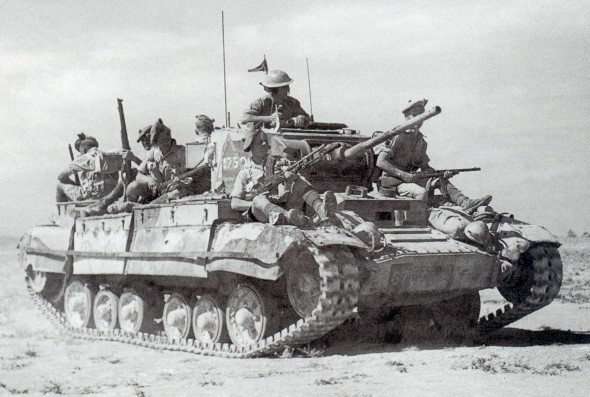
Cruiser Mk I / A9

The Tank, Cruiser, Mk I (A9) was a British cruiser tank of the interwar period. It was the first cruiser tank: a fast tank designed to bypass the main enemy lines and engage the enemy's lines of communication, along with enemy tanks. The Cruiser Mk II was a heavier armoured adaptation of the Mark I, developed at much the same time.
In 1936, the British War Office designated two different kinds of tanks for future development: heavily armoured infantry tanks to be used in close co-operation with infantry during attacks, and fast mobile cruiser tanks designed to make forays deep into enemy territory.

In 1934, Sir John Carden of Vickers-Armstrong was asked to provide a "reasonably cheap tank" as a replacement for some of the medium models then in use. The pilot model of his design was finished in 1936 and given the designation A9E1.
It incorporated the best features of the earlier Mk III Light Tank, and was powered by a commercial petrol engine. However, this was still in the time of the Great depression and the tank had a number of cost-cutting measures applied. It was the first British tank to have a centrally located turret and to have powered traverse. 

The system was by Nash & Thompson and similar to that being introduced on the Vickers Wellington bomber aircraft. The armour was light, with a maximum of 14 mm thickness. Many armour faces were vertical, and there were numerous shot traps, but it could achieve 25 mph and carried the new high velocity QF 2-pounder (40 mm) gun.
The driver's compartment and the fighting compartments were not separated. As well as the turret armament, which consisted of a Ordnance QF 2 pounder gun and a coaxial Vickers machine gun, there were two small turrets either side of the driver's compartment, each with a Vickers machine-gun. Both these smaller turrets were permanently manned, which gave the tank a total crew of 6 (Commander, gunner, loader, driver and two machine-gunners).

The A9E1 was tested against other designs and -although lacking in some areas - it was accepted in 1937 as an interim design until a Christie suspension cruiser tank could be delivered. An order was placed for 125. 
Seventy-five were built by Harland and Wolff, and the other 50 were built by Vickers. 
Originally, a Rolls-Royce car engine was used, but this proved underpowered and was replaced by an AEC bus engine.

The later Valentine Infantry tank essentially used the same lower hull and suspension, though with considerably more armour.
The A9 weighed 12 tons, was 5.8 metres long, 2.65 metres high, 2.5 metres wide, and had a top speed of 25 mph on road and 15 mph off. Its maximum road range was 150 miles. The ammunition load was 100 2-pounder rounds and a total of 3,000 rounds for the three Vickers machine guns.
The Mark I cruiser began to be delivered in January 1939.

The Cruiser was an effective tank in the French, Greek and early North African campaigns. The 2 pdr gun was lethal against the early Italian tanks encountered during the North African campaign and could hold its own against Rommel's early Panzer IIs and IIIs. The A9's 2-pounder gun could also breach the 20 – 30 mm of protective steel on later opponents, such as the Panzer III ausf D and the Panzer IV ausf D variants. It was effective until the Germans introduced the more thickly armoured Panzer IV ausf E variant to the desert in the Spring of 1941.
However, its minimal armour made the A9 very vulnerable against most Axis anti-tank weapons. Also problematic was the lack of high explosive shells for the 2 pdr gun, and even worse the lack of armor-piercing shells for the 95 mm gun on the Close Support version. Another issue was that the areas around the front machine gun turrets created a frontal surface that was more vulnerable to enemy fire than it would have been had it been a flat plate, let alone a sloped glacis.

The mechanical unreliability of the Cruiser was also a disadvantage. In particular, tracks were easily slewed causing difficulties.

Mark I (A9) used by the 1st Armoured Division in the Battle of France (1940). 
Used by the 2nd and 7th Armoured Divisions in North Africa until 1941.
Mark I CS, had a 3.7 inch (94 mm) /L15 breech-loaded mortar instead of the 2-pounder gun. 40 rounds, mostly smoke, were carried.
Tank, Cruiser, Mk I (A9)
Mk1CruiserTank.jpg
Tank, Cruiser, Mk I (A9)
TypeCruiser tank
Place of origin United Kingdom
Service history
In service1938–1941
Used byBritish Army
WarsSecond World War
Production history
DesignerSir John Carden
ManufacturerVickers
Produced1936–1941
Number built125
Specifications
Weight12 tons
Length19 ft (5.8 m)
Width8 ft 4 in (2.5 m)
Height8 ft 8 in (2.65 m)
Crew6 (Commander, gunner, loader, driver, 2x MG gunners)

Armour6 - 14 mm
Main
armament
QF 2-pdr
100 rounds
Secondary
armament
3 x 0.303 Vickers machine gun
3,000 rounds
EngineAEC 179 6-cylinder petrol[1]
150 hp (110 kW)
Suspensionsprung triple wheel bogie
Operational
range
150 miles (240 km)
Speed25 mph (40 km/h)

27.2.2016

Mannerheim Line 1939 -1940 Линия Маннергейма

                         ----------------------------------------------------------------------------
                       MUUTAMIA TANKKI KUVIA - SOME TANK PICTURES
                         ----------------------------------------------------------------------------
                 

23.2.2016

Valentine tank

The Tank, Infantry, Mk III, Valentine was an infantry tank produced in the United Kingdom during the Second World War. More than 8,000 of the type were produced in eleven marks, plus various specialised variants, accounting for approximately a quarter of wartime British tank production. The many variants included riveted and welded construction, petrol and diesel powerplants and a progressive increase in armament. It was supplied in large numbers to the USSR and built under licence in Canada. Developed by Vickers, it proved to be both strong and reliable
There are several proposed explanations for the name Valentine. According to the most popular one, the design was presented to the War Office on St. Valentine's Day, 14 February 1940, although some sources say that the design was submitted on Valentine's Day 1938 or 10 February 1938. 


White notes that "incidentally" Valentine was the middle name of Sir John V. Carden, the man who was responsible for many tank designs including that of the Valentine's predecessors, the A10 and A11. Another version says that Valentine is an acronym for Vickers-Armstrong Ltd Elswick & (Newcastle-upon) Tyne. The "most prosaic" explanation according to David Fletcher is that it was just an in-house codeword of Vickers with no other significance.
The Valentine was extensively used in the North African Campaign, earning a reputation as a reliable and well-protected vehicle. The first tanks in action were with the 8th Royal Tank Regiment in Operation Crusader. Some tanks had managed more than 4,800 kilometres (3,000 mi) by the time the British Army reached Tunisia. 


The tank first served in Operation Crusader in the North African desert, when it began to replace the Matilda Tank. Due to a lack of cruiser tanks, it was issued to armoured regiments in the UK from mid-1941. The Valentine was better armed and faster than the Cruiser Mark II.

The Valentine shared the common weakness of the British tanks of the period: its 2-pounder gun lacked high-explosive (anti-personnel) ammunition and soon became outdated as an anti-tank weapon. Introduction of the 6-pdr in British service was delayed until the loss of equipment at Dunkirk had been made good, so the 2-pdr was retained longer. The small size of the turret and of the turret ring, meant that producing mountings for larger guns proved a difficult task. 

Although versions with the 6-pounder and then with the Ordnance QF 75 mm gun were developed, by the time they were available in significant numbers, better tanks had reached the battlefield. Another weakness was the small crew compartment and the turret for only two men. 

A larger turret, with a loader position added, was used in some of the 2-pounder versions but the position had to be removed again in variants with larger guns. Its relatively low height was an advantage in a battlefield with little cover, allowing it to take up a "good hull-down position in any convenient fold in the ground".
--------------------
Valentine III
specifications
Full name: Infantry Tank Mark 
Crew: 3 commander, gunner and a driver (Mark I)
Crew: 4 commander, driver, shooter, a loader (mark-III)
Weight: 17 tons (Valentine VIII-XI 18 tons).
Length: 5.4 m (Valentine VIII to XI 5.9 meters).
Width: 2.6 m (roll width of 35.56 centimeters).
Height: 2.3 meters.
Armament: O.Q.F. 2-pounder (40 mm cannon PSV).
Armor thickness: 65 mm at its thickest, the thinnest 8 mm.
Engine: varies by version.
Top speed on the road: 24 km / h.
Top speed terrain: around 13 km / h.
Action Trip: about 145 km.
--------------------
Jalkaväkitankki Mk. III Valentine on Vickers-Armstrongin kehittämä panssarivaunu, ja se oli käytössä toisessa maailmansodassa. Valentineja rakensi Vickers-Armstrongin lisäksi Metropolitan-Cammell ja Birmingham Carriage & Wagon. Valentineja valmisti myös Kanadassa kanadalainen Pacific Car & Foundry.

Valentine oli yksi tärkeimmistä brittiläisistä tankeista toisessa maailmansodassa ja vuonna 1943 se muodosti määrältään lähes neljäsosan Ison-Britannian tankeista. 
Vuoden 1938 alkupuolella Vickers-Armstrong halusi osallistua jalkaväkitankki Mk. II (A12):n tuottamiseen. Sen sijaan Vickersiltä pyydettiin uuden tankin suunnittelemista joka perustuisi vanhaan A10 Cruiser Mk II -malliin. Vickers suostui pyyntöön, sillä yhtiöllä oli kokemusta A10-mallin rakentamisesta, ja tuo kokemus olisi mennyt hukkaan, jos se olisi siirtynyt rakentamaan A12:ta.
Vickers-Armstrongin uusi tankki oli rungon, jousituksen, moottorin ja vaihteiston osalta sama kuin A10, mutta torni olisi raskaammin panssaroitu ja aseistuksena oli täysin uusi 2-naulainen 40-millinen tykki. Suunnitelmat saatiin valmiiksi ystävänpäivänä (Isossa-Britanniassa St. Valentine's Day) helmikuussa 1938. Siitä sanotaan nimen Valentine tulevan.
Kuitenkin meni yli vuosi ennen kuin tilaus Valentinesta tuli. Vuoden 1939 heinäkuussa sota näytti väistämättömältä ja Isolle-Britannialle tuli kiire saada lisää panssarivaunuja. Vickers-Armstrongilta tilattiin 275 Valentinea ennen kuin edes mallikappaletta oli rakennettu. Vickers lupasi pystyvänsä nopeaan tuotantoon, koska runko oli vanhasta A10:stä, ja siten säästettiin aika, joka muuten olisi tarvittu uuden rungon suunnitteluun.
Ensimmäinen Valentine luovutettiin armeijalle testejä varten toukokuussa 1940. Se suoriutui testeistä hyvin sen osoittautuessa mekaanisesti luotettavaksi. Ensimmäiset palveluskäyttöön tarkoitetut Valentinet luovutettiin armeijalle myöhään vuonna 1940. Sitä käytettiin vuosina 1940–1941 panssariyhtymien kalustona ns. cruiser-tankin roolissa, koska oikeista cruiser-tankeista oli pulaa.


Valentinen vanhanaikaisuus huomattiin jo vuoden 1941 loppupuolella. Se oli hidas ja pieni torni esti suuremman tykin asentamisen. Valentine III ja Valentine IV -versioissa oli isompi torni, jotta sinne mahtuisi kolme miehistön jäsentä (johtaja, ampuja ja lataaja). Miehistön määrä jouduttiin kuitenkin vähentämään takaisin kahteen, jotta torniin mahtuisi isompi tykki. Yleisesti Isossa-Britanniassa haluttiin, että sen tankkien tornimiehistö olisi kolme, mutta vaatimuksesta jouduttiin nyt tinkimään, koska Valentineen haluttiin suurempi tulivoima. 

22.2.2016

Ehrhardt E-V/4

Ehrhardt E-V/4 oli saksalaisen Ehrhardtin valmistama panssariauto, jota käytettiin ensimmäisessä maailmansodassa sekä Sleesian kansannousuissa. 

Niiden suunnittelu aloitettiin, koska saksalaiset olivat havainneet belgialaisten panssariauton tehokkuuden. Länsirintamalla Ehrhardt E-V/4:ta ei kuitenkaan käytetty juoksuhautojen takia, mutta se osoittautui tehokkaaksi itärintamalla. 
Versailles’n rauha ei kieltänyt saksalaisilta panssariautoja, joten asevoimat tilasi sodan jälkeen lisää panssariautoja. 
Sleesian kansannousuissa sitä käyttivät sekä saksalaiset että puolalaiset joukot.
---------------------
Panssaroidun auton idea kehittyi ensimmäisen maailmansodan varhaisessa vaiheessa, kun havaittiin, että ratsu- ja jalkaväen käyttö tuli mahdottomaksi konetuliaseiden takia. Belgialainen Minerva suunnitteli maan asevoimille tavalliseen tourer-autoon perustuneen ensimmäisen panssariauton. Myös briteillä oli käytössään panssariautoja.

Panssariautojen avulla voitiin hyökätä vihollisen konekivääripesäkkeiden kimppuun joko ajamalla suoraan esteiden läpi tai nopealla yllätysiskulla. Panssariautoilla kyettiin kulkemaan maastossa kohtalaisella vauhdilla. Ajoneuvojen edut kävivät selviksi sodan edetessä.

Saksalaiset päättivät aloittaa lokakuussa 1914 oman panssariauton kehittämisen, kun olivat havainneet Minervan tehokkuuden. Valmistajiksi olivat tarjolla Büssing, Daimler ja Erhardt. Prototyypit Daimler/15, Büssing A5P ja Panzerkraftwagen Erhardt E-V/4 valmistuivat heinäkuussa 1915. 
Ehrhardtin auto muistutti läheisesti Daimlerin valmistamaa prototyyppiä, kun taas Büssingin suunnittelema malli oli kooltaan suurempi. Kaikki autot olivat hyvin painavia, sillä ne olivat läpikotaisesti panssaroituja. Autojen etenemistä haittasivat huono näkyvyys ja huonokuntoiset, mutaiset tiet.

Sodan aikana länsirintamalle oli kaivettu runsaasti juoksuhautoja, jotka vaikeuttivat panssariauton käyttöä, minkä takia Saksan sodanjohdon mielenkiinto panssariautoihin väheni. Syksyllä 1916 kolmesta prototyypistä muodostettiin yksikkö nimeltään Panzerkraftwagen MG-Zug 1, joka lähetettiin itään Romanian vastaiselle rintamalle. Panssariauto osoitti siellä etunsa, ja saman vuoden lopulla asevoimat tilasi 12 Ehrhardtin ajoneuvoa.

Prototyyppiin verrattuna tuotantomallia oli kevennetty 1,75 tonnia, pohjaan oli asennettu panssari ja jäähdyttimen edessä oli säädettävä suojasäleikkö, jonka voi kääntää jäähdyttimen suojaksi ohjaamosta käsin. Etuvalojen ympärille ja takapyörien sivuille lisättiin panssarointi. Autoon tuli kääntyvä tykkitorni, ja ampumaluukkujen suojausta oli parannettu. 
Varusteeksi lisättiin radiolähetin, joka kuitenkin vei paljon tilaa ja jota pystyi käyttämään vain auton ollessa paikallaan. Malli hyväksyttiin Saksan asevoimien käyttöön nimellä Panzerkraftwagen Ehrhardt 1917. Uudet autot lähetettiin suoraan itärintamalle. Ne palvelivat menestyksekkäästi Ukrainan rintamalla vuonna 1918 ja niitä käytettiin myös Italian vastaisella rintamalla.

Ainakin yhden yksilön tiedetään päätyneen venäläisten käsiin.

Marraskuussa 1918 Saksa allekirjoitti aseleposopimuksen ympärysvaltojen kanssa. Vuonna 1919 solmitussa Versailles’n rauhansopimuksessa Saksan asevoimien kokoa ja kalustoa rajoitettiin. Asevoimien suuruus sai olla korkeintaan 100 000 henkilöä, ja panssarivaunut kiellettiin. 

Saksassa ei saanut enää valmistaa lentokoneita. Panssariautoja sitä vastoin ei kielletty, ja Ehrhardtilta tilattiin jo vuoden 1919 puolella uusi 20 ajoneuvon erä. Autot vastasivat muilta osin vuoden 1917 malleja, paitsi panssaroinnissa jouduttiin käyttämään heikompilaatuista terästä materiaalipulan tähden.
Sekä saksalaiset että puolalaiset käyttivät Ehrhardteja Sleesian vuosien 1919–1921 kansannousuissa. Puolalaisten käyttämistä ajoneuvoista kaksi oli vallattu saksalaisilta, mutta pidetään mahdollisena, että kapinalliset olisivat saaneet Ranskasta toimitettuja ympärysvaltojen sotasaaliina saamia ajoneuvoja.

Erhardtit säilyivät asevoimien käytössä lähes toisen maailmansodan alkuun asti.

Auton rakenne oli peruspiirteiltään tavanomainen. Pyörät olivat nelipuolaiset, takana oli paripyörät. Voimanlähteenä ollut bensiinikäyttöinen 80-hevosvoimainen moottori sijaitsi edessä, ja kuljettajan paikka oli sen takana. Auton takaosassa oli miehistötila, jonka seinissä oli ampumaluukut ja katossa konekivääritorni. 
Autoon pystyi asentamaan enimmillään kuusi 7,7-millistä konekivääriä. Autoon mahtui 1 250 konekiväärin ammusta. Miehistön määrä oli enintään yhdeksän. 

Taistelukentällä auton tunnisti perinpohjaisessta panssaroinnistaan.


Ehrhardt E-V/4
Ehrhardt 1.jpg

Aseen tyyppipanssariauto
AlkuperämaaSaksan keisarikunnan lippu Saksan keisarikunta
Palvelushistoria
Valtion käytössäSaksan keisarikunnan lippu Saksan keisarikunta
Puolan lippu Puola
Neuvosto-Venäjän lippu Neuvosto-Venäjä
Sodissaensimmäinen maailmansota
Sleesian kansannousut
Valmistushistoria
Suunniteltu19151917
ValmistajatHeinrich Ehrhardt
Valmistusvuodet19151919
Valmistettu yhteensä33 kappaletta
Tekniset tiedot
Paino7,75 tonnia
Pituus5 300 mm
Leveys2 000 mm
Korkeus2 900 mm
Miehistö8–9 henkilöä

Kaliiperi7,92 mm
Panssarointi6–9 mm
Moottori8 490 cm³
80 hv
Toimintasäde250 km
Huippunopeus61,3 km/h
---------------------
The E-V/4 Panzerkraftwagen Ehrhardt was one of the first examples of a type of high and flatsided armoured car design that the Germans used almost until the start of the Second World War for internal policing duties. It weighed nearly 9 tons, had a crew of eight or nine, and carried an armament of up to three machine-guns.

The very first German armoured cars were special large car or truck chassis adapted to carry a skyward-looking artillery piece for use against observation balloons. These vehicles were collectively known as Ballon Abwehr Kanonen (BAK), though none were taken into large-scale use.

The Belgians were the first to demonstrate the potential of the armoured car in mobile warfare, with the Minerva Armoured Car. German infantry and cavalry were at times distinctly inconvenienced by the hit-and-run tactics employed by the Belgian armoured cars. Having suffered somewhat at the hands of these vehicles, the German Army decided to produce its own armoured car, but without any practical experience they approached the car manufacturing companies Ehrhardt, Daimler and Büssing, and ordered a prototype armoured car from each.

During 1915, the three companies produced the ordered prototypes. In all three cases, the companies chose to ignore the fact that the Belgian armoured cars were little more than converted touring cars, and developed what they perceived to be more suitable vehicles. As a result, all three prototypes were massive vehicles, the largest of which were the Büssing. This vehicle used a 'double-ended' layout that could at least pose a tactically useful high ground clearance. 

The Ehrhardt and Daimler designs were very similar. Both placed the engine in the front, surrounded by armour, and had a large box-like body at the rear with a turret or cupolas on the top. Both sported a clumsy appearance, and was far too heavy for the effective fulfillment of the operational tasks the German Army demanded of them.

The Daimler and Ehrhardt prototypes were both reliant on the use of double wheels on each side of the rear, and had flanges on the single wheels at the front of the vehicle, in an effort to reduce ground pressure and so enhance the cross-country mobility of the vehicle to a useful degree. All three cars had a crew of eight or nine men, carried an armament of at least three machine guns, and possessed a maximum armour thickness of 9 mm.
Operational history
Along with some improvised conversions, the three prototypes were formed into one unit and sent to first the Baltic and then to the Western Front. Conditions on both fronts were so bad that armoured cars could achieve very little, and the vehicles were eventually deployed on the Russian part of the Eastern Front, where they could at least use their mobility to some effect. It was then that there emerged a need for more vehicles, and so Ehrhardt was contracted to build a further 20 vehicles. 

These vehicles were 1.72 tons lighter than the original Panzerkraftwagen Ehrhardt 1915. Designated the Panzerkampfwagen Ehrhardt 1917, these vehicles were completed with revised frontal armour. The vehicles were sent to the Eastern Front and served there until the end of the fighting there late in 1917. Thereafter they were retained in Germany for internal policing duties. 
They were so successful in this role that an additional 20 vehicles were ordered and produced in 1919. The E-V/4 was in fact considered just what internal policing required, for its height gave it the capacity to tower over crowds and offer police units better control of riots. E-V/4's were in use almost until World War II.

The requirement for armoured cars were so high that by 1918, the Germans were forced to employ numbers of captured armoured cars of Rolls-Royce or other make, and the Ehrhardt vehicles were never around in sufficient numbers. On the Eastern Front the cars were never able to make much of a tactical impression, and so the design is now little known and few operational details have survive

21.2.2016

FCM F1


The FCM F1 was a French super-heavy tank developed during the Interwar period by the Forges et Chantiers de la Méditerranée company. Twelve were ordered in 1940 to replace the Char 2C, but France was defeated before construction could begin, a wooden mock-up being all that was finished. 

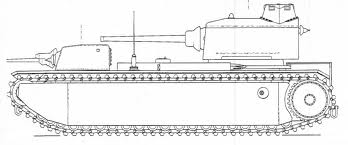
The FCM F1 was large and elongated, and had two turrets: one in front and one in the back, with a single high-velocity gun in each turret. The rear turret was higher so it could shoot over the first one. 
                         
The vehicle was intended to be heavily armored. Its size and protection level made it early 1940 with about 140 tons, the heaviest tank actually ordered. Despite two engines its speed would have been slow. 
                                         
The primary purpose of the tank was to breach German fortification lines, not to fight enemy tanks. The development path of the FCM F1 was extremely complex, due to the existence of a number of parallel super-heavy tank projects with overlapping design goals, the specifications of which were regularly changed. For each project again several companies submitted one or more competing
After the Fall of France all official design on heavy/super-heavy tanks was halted. The Char F1 showed quite a few similarities though to the ARL 44, produced just after the war. In 1944 the Allies had developed some new vehicles with exactly the same purpose as the FCM F1: to breach the "Siegfried Line". The British had the Tortoise heavy assault tank, the Americans the Super Heavy Tank T28. Both designs were self-propelled guns however, not multi-turreted tanks, allowing them to be lighter and still better protected. Like the FCM F1 they would not be placed into production.


FCM F1
FCM-F1.svg
TypeSuper-heavy tank
Place of origin France
Specifications
Weight139 metric tons
Length10.53 m
Width3.10 m
Height4.21 m
Crew9

Armour100 mm
Main
armament
90 mm DCA gun
Secondary
armament
47mm SA37 gun and six machine guns
Enginetwo Renault V12 KGM of 550 hp
1100 hp total
Power/weight7.9 hp/t
Suspensionvertical coil springs
Operational
range
200 km
Speed20 km/h

19.2.2016

Sd. Kfz. 1 Type 170 VK

170 V (tuote merkintä oli: W 136-sarja) oli Mercedes-Benzin valmistama henkilöauto, josta oli mallit 260 D 170 H ja esitettiin helmikuussa 1936 Berliinin kansainvälisessä autonäyttelyssä.

170 V (product code was: W136 series) were manufactured by Mercedes-Benz passenger car, which had models 260 D 170 H, and in February 1936 Berlin International Auto Show.
Auto perustui W136 sarjan VK 170 mallin henkilöautoon. Se oli kestävä ja luotettava
mutta sen maavara oli riittämätön sotilas käytössä, eikä sopinut maastossa ajoon.

Type VK 170 Kübelwagen what developed based on the type of commercial 170 V passenger car. The car was very reliable and durable. As a small gap, insufficient cross-country mobility.


Sotaa edeltäneestä automallista Daimler-Benz rakensi W 136, toisen maailmansodan jälkeen. 
Vuonna 1953 tilalle tuli täysin uudistettu W 120, joka oli 1,8-litrainen moottori 170 S.

Pre-war made car model Daimler-Benz W136, was replaced entirely in 1953, when became completely redesigned W 120, which was a 1.8-liter engine 170 S.


Sotaa edeltäneestä automallista Daimler-Benz rakensi W 136, toisen maailmansodan jälkeen. 
Vuonna 1953 tilalle tuli täysin uudistettu W 120, joka oli 1,8-litrainen moottori 170 S.


15.2.2016

Partisan attacks 1941 - 1944 Partisaanit iskevät

During the Finnish control of Eastern Karelia, many ethnic Russians and some Karelians supported the partisan attacks.

Approximately 5,000 partisans altogether fought in the region, although the typical strength of the force was 1,500–2,300. Peculiarities of this front were that partisan units were not created inside occupied territory, but their personnel came from all over the Soviet Union and that they mainly operated from the Soviet side of the front line.

The only major Soviet Partisan operation ended with failure when the 1st Partisan Brigade was destroyed at the beginning of August 1942 at Lake Seesjärvi. Most operations at the southern part of the front consisted only of a few individuals, but in the roadless northern part, units of 40–100 partisans were not uncommon. 


                                                          Partisan political officer Razumov

Partisans distributed propaganda newspapers, "Truth" in the Finnish language and "Lenin's Banner" in the Russian language. One of the more notable leaders of the partisan movement in Finland and Karelia was the future leader of the USSR, Yuri Andropov. 

In East Karelia, most partisans attacked Finnish military supply and communication targets, but inside Finland proper, almost two-thirds of the attacks targeted civilians,  killing 200 and injuring 50, mostly women, children and elderly.  On one occasion in the small village the partisans murdered all civilians, leaving no witnesses to the atrocities. One such incident was the attack of Lämsänkylä Kuusamo on July 18, 1943, in which the partisans attacked a lonely house and killed all of the seven civilians there, including a six-month-old baby and a three-year-old child, before fleeing. 

Partisan operations against Finns were estimated as being highly ineffectual. The partisans did not have sufficient strength to attack military targets, and would often falsely report their raids to higher command, claiming attacks on German or Finnish military targets even if the victims were civilians. Already in the autumn of 1941 the report of Komissariat of Interior Affairs was highly critical, and it became only worse, as stated in the counter-intelligence agency's report of April 1944. 
                                                  Russian partisan / patrol man
The main explanations given for the operations' failures were the isolated headquarters at Belomorsk, which did not know what operative units were doing, personnel who had no local knowledge and were partly made up of criminals (10-20% of all personnel were conscripted from prisons) without knowledge of how to operate in harsh terrain and climate, efficient Finnish counter-partisan patrolling (more than two-thirds of the infiltrating small partisan groups were completely destroyed) and Finnish internment of the ethnic Russian civilian population in concentration camps from those regions with active partisan operations. 


                                  Finnish prisoner, who are captured of russian patrol

Internees were released to secure areas, preventing partisans from receiving local supplies. In addition, many Soviet Karelians reported to the Finns the movements of the partisans and did not support the Soviet Partisans.


                             Partisan surrender and say goodbye binocular rifle

Partisans carried out several operations in Finland and Eastern Karelia, 1941, 1944. large one failed after the first Partisan Brigade was destroyed at the beginning of August 1942 the lake Seesjärvi. Partisans distributed propaganda newspaper Pravda in Finnish and Russian Lenin's Banner. One of the leaders of the partisan movement in Finland and Karelia was Yuri Andropov.

Finnish sources, partisan activity in eastern Karelia focused mainly on Finnish military supply and communication targets, but almost two thirds of the Finnish side of the border attacks targeted civilians, killing 200 and injuring 50, including children and the elderly

                                            After the battle. 

                Finnish soldier watch soviet partisan wounded and dead nurse
-----------------------
Soviet Partisans make about 45 hit the country villace, time to Continuation War (1941-1944) as well as individual civilians against the road or hay meadows or field


In addition attacks were made against vehicles and truck escorts / transports and they destroy these, captures many finnish prisoners and kill some of theys put mostly taken and walking they over the border.


The attacks are mainly focused on small, separate villages, or groups of products. 
In the villages could be the beginning of the year 1942, the protection of civilians to be of a few men patrol group. Residents are typically killed in gunfire, some were taken prisoner and executed later (see. Seita Lake partisaanihyökkäys). All residents of villages in the fate of the missing is not known.

Captured soldiers partisans hit they hands the bayonet to tree stump, interrogation and execution by the shoting forehead, this was the most common method.


                                     raped and killed, many bayonet hits

                                         Ritva three month old girl, five hit of bayonet
Partisans toy: Captured five years Finnish little girl murdered in the wilderness,
the body of a full cut and puncture wounds, partisans nail and tooth marks.
We can imagine what kind sense and pleasure that his blood with terror crying, struggling helplessly little creature has attracted adults torturer.
And last, killed many bayonet blow
                                             Old housewife and a little girl of 5 year
                                  14 year old girl, rape and kill bayonet hit and shots

        12 years girl, hit the head rifle butt, raped and wrapped in a towel, and shots
                      Searching dead bodies of the ruins of the destroyed home house
                                                      They find a family
                                                  the escape of nearly succeed
                                                         I had time to two months old


                              The son of two year, the youngest victim of this village
-----------------------------------------------
                                                      Trackers patrol chase 


                                    Chase (hunting and destroy) group / patrol

Partisan team is besieg and these partisan soldiers are surrendered, no food and a many their population are cutting they many small team, and these destroy one by one. Passionate and continuous hunting, and fear of of revenge make soon end to all persistent man, if the hunter can be able to follow their enemy.

                    Finnish soldiers and Soviet POWs with their wounded comrade.

Neuvostopartisaanit tekivät jatkosodan aikana vuosina 1941–1944 yhteensä 45 iskua kyliin sekä yksittäisiä siviilihenkilöitä vastaan maanteillä tai heinäniityillä Kuhmon, Kuusamon, Lieksan, Liperin, Sallan, Savukosken, Sodankylän ja Suomussalmen kuntien alueella. Lisäksi tehtiin hyökkäyksiä ajoneuvoja ja ajoneuvosaattueita vastaan sekä vietiin suomalaisia vankeina rajan taakse. Partisaani-iskuissa menehtyi 181 siviiliä. Suomen vastaista partisaanitoimintaa johti Juri Andropov

Hyökkäykset kohdistuivat pääasiassa pieniin, erillisiin kyliin tai taloryhmiin. Kylissä saattoi vuoden 1942 alusta lähtien siviilien suojana olla muutamasta miehestä koostuva vartioryhmä. Asukkaita kuoli tyypillisesti tulituksessa, osa saatettiin ottaa vangiksi ja teloittaa myöhemmin (ks. Seitajärven partisaanihyökkäys). Kaikkien kylistä kadonneiden asukkaiden kohtaloa ei tiedetä.

Tavallisia olivat myös hyökkäykset saattueita ja yksittäisiä ajoneuvoja vastaan. Tunnettu tällainen hyökkäys tehtiin Laanilassa, Inarissa 4. heinäkuuta 1943. Hyökkäyksessä sai surmansa muun muassa Oulun piispa Yrjö Wallinmaa. Toinen tunnettu hyökkäys tapahtui Kuusamon Murtovaarassa 5. heinäkuuta 1942 ja siinä saivat surmansa Suomen Sotilaskotiliiton puheenjohtaja Toini Jännes sekä sotilaskotisisaret Greta Palojärvi ja Fanni Aflecht. Heidän mukanaan kaatuivat myös molemmat armeijan autonkuljettajat, korpraalit Veikko Ilmari Moilanen ja Toimi Ilmari Rossinen

Partisaanihyökkäykset ovat olleet sodanjälkeisessä Suomessa virallisesti vaikeasti käsiteltävä aihe. Vastaavasti Neuvostoliitosta ja myöhemmin Venäjältä saatuja kuvauksia partisaanitoiminnasta eivät suomalaiset ole pitäneet uskottavina. Siviilikyliin kohdistuneista partisaanihyökkäyksistä on ilmestynyt kirjallisuutta. Helge Seppälän "Neuvostopartisaanit toisessa maailmansodassa" (1971) mainitsee mm. Kuoskuun 3. syyskuuta 1941 tapahtuneen tuhoiskun. Pentti Tikkasen "Partisaanit hyökkäävät" ilmestyi 1972, Eino Viheriävaaran "Partisaanien jäljet 1941–1944" julkaistiin 1982. 

Mutta vasta vuonna 1997 ilmestynyt Ville Tikkasen "Partisaanien uhrit" pääsi laajana artikkelina Helsingin Sanomien sivuille ja vuoden 1998 kesällä julkaistu Tyyne Martikaisen omakohtaisista kokemuksista virinnyt kirja "Neuvostoliiton partisaanien tuhoiskut siviilikyliin 1941–44" pääsi Huomenta Suomen aamulähetykseen ja avasi sotarikoskeskustelun. Saman vuoden syksyllä ilmestynyt Veikko Erkkilän kirja "Vaiettu sota" jatkoi keskustelua neuvostopartisaanien sodanaikaisesta toiminnasta Suomen rajojen sisäpuolella.


Voimakkaasti virinnyt julkinen keskustelu sai aikaan valtionsyyttäjän määräämään poliisikuulustelut tapahtuneista partisaanihyökkäyksistä.